
Senegal’s Political Earthquake Sparks Uncertainty After President Faye Fires Prime Minister Sonko
- Entertainment Featured Politics World
Anyaele Happiness
- 0
- 7 minutes read
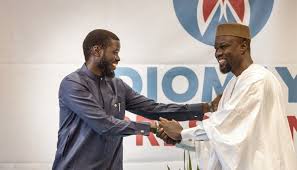
Senegal is facing one of its most dramatic political moments in recent years after President Bassirou Diomaye Faye dismissed Prime Minister Ousmane Sonko and dissolved the entire government following months of growing tensions between the two former allies. The shocking move has triggered widespread debate across Africa and raised serious questions about the future of Senegal’s leadership, economy, and political stability.
The dismissal was officially announced during a late-night national television broadcast, where presidential officials confirmed that Sonko’s removal automatically dissolved the cabinet and ended the functions of government ministers. The announcement came after weeks of visible disagreements between President Faye and Sonko over economic policies, governance style, and the direction of the ruling party.
For many Senegalese citizens, the political breakup feels almost unbelievable because both men were once viewed as inseparable political partners who symbolized a new era of leadership in Senegal. Ousmane Sonko, a charismatic opposition figure and one of the country’s most influential political voices, played a major role in helping Bassirou Diomaye Faye win the 2024 presidential election after Sonko himself was barred from contesting due to a legal conviction.
Their alliance became one of the most powerful political movements in Senegal’s modern history. Together, they energized millions of young voters who were frustrated with corruption, unemployment, rising living costs, and the long rule of the previous administration under former President Macky Sall. The victory of the Pastef party in 2024 was widely celebrated as a political revolution that promised transparency, reform, and economic transformation.
However, despite their public image of unity, tensions reportedly began growing behind closed doors soon after they took power. Political analysts say disagreements emerged over how Senegal should handle its worsening economic crisis, relations with international lenders, and internal control of the ruling party. Sonko reportedly opposed certain economic reforms linked to negotiations with the International Monetary Fund (IMF), while President Faye appeared more willing to cooperate with international financial institutions to stabilize the country’s finances.
Senegal is currently facing serious economic pressure after an audit reportedly uncovered hidden debts and financial liabilities that pushed the country’s debt burden to extremely high levels. The IMF responded by freezing a major financial support program worth approximately $1.8 billion, placing additional pressure on the government to implement economic reforms and debt restructuring plans.
The economic crisis has become one of the biggest challenges facing Senegal’s leadership. Rising debt, inflation, fuel subsidy concerns, and unemployment have increased pressure on the government to deliver quick solutions. Analysts believe disagreements over how to manage the crisis may have deepened the divide between Faye and Sonko over recent months.
Observers also point to growing political rivalry between the two leaders. Although Bassirou Diomaye Faye currently serves as president, Ousmane Sonko remains one of the most popular political figures in Senegal and still commands strong influence within the ruling Pastef party. Some analysts believe the relationship became increasingly difficult because both men represented powerful centers of authority inside the same government.
The tension became more visible after Sonko publicly criticized aspects of government leadership during parliamentary discussions. Reports suggest that internal disagreements over party control, state appointments, and future political ambitions contributed to the collapse of the alliance.
Despite his dismissal, Sonko appeared calm in his first public reaction. Shortly after the announcement, he posted a brief message on social media saying he would “sleep soundly tonight,” while supporters gathered outside his residence in Dakar to cheer him on. The reaction highlighted the continued loyalty and popularity he enjoys among many Senegalese citizens, particularly young people who still view him as the face of political change.
Only days after Sonko’s removal, President Faye appointed economist Ahmadou Al Aminou Lo as Senegal’s new prime minister. Lo, a former executive at the Central Bank of West African States, is expected to focus heavily on restoring investor confidence and stabilizing Senegal’s troubled economy.
The appointment of a technocrat rather than a major political figure signals that President Faye may now prioritize economic management and international financial negotiations over political activism. However, the decision could also deepen divisions inside the ruling party if Sonko’s loyal supporters feel excluded from power.
Political uncertainty is now growing across Senegal as citizens wait to see whether the crisis will calm down or escalate further. Some analysts fear the fallout could weaken the unity of the Pastef movement that brought both men to power. Others believe the conflict could eventually reshape Senegal’s political future ahead of the 2029 presidential election, especially if Sonko attempts a political comeback.
There are also concerns that instability at the top of government could affect Senegal’s reputation as one of West Africa’s most politically stable democracies. For years, Senegal has been viewed as a relatively peaceful country in a region affected by military coups, political violence, and constitutional crises. The current tensions are therefore being watched closely across Africa and internationally.
Social media discussions inside Senegal have exploded since the announcement, with supporters on both sides debating who is responsible for the collapse of the alliance. Some citizens blame political ego and internal power struggles, while others argue that difficult economic realities made conflict unavoidable. Online discussions have become highly emotional as many people feel disappointed watching two leaders who once represented hope now publicly divided.
At the same time, some political observers believe the split was inevitable because the partnership between Faye and Sonko was built more on political necessity than long-term compatibility. Sonko’s strong personality and grassroots popularity often overshadowed the presidency itself, creating an unusual power structure inside the government.
The coming weeks will likely determine whether Senegal moves toward political stabilization or deeper division. Much will depend on how President Faye manages relations with the Pastef party, how Sonko responds politically after his dismissal, and whether the new government can quickly address the country’s economic challenges.
For millions of Senegalese citizens, the political crisis is more than just a leadership dispute. It is a defining moment that could shape the future of governance, democracy, and economic recovery in one of Africa’s most closely watched nations. As uncertainty continues to grow, many people across the continent are now watching Senegal carefully to see what happens next.
